The Publishing Times
All the News That’s Fit to Publish
publishing-news · Guides
National Writers Union Condemns AI Companies' 'Scan-and-Destroy' Book Operations
The NWU says AI companies are buying print books, slicing off the bindings, scanning the pages and throwing the paper away, and that rare titles could vanish for good.
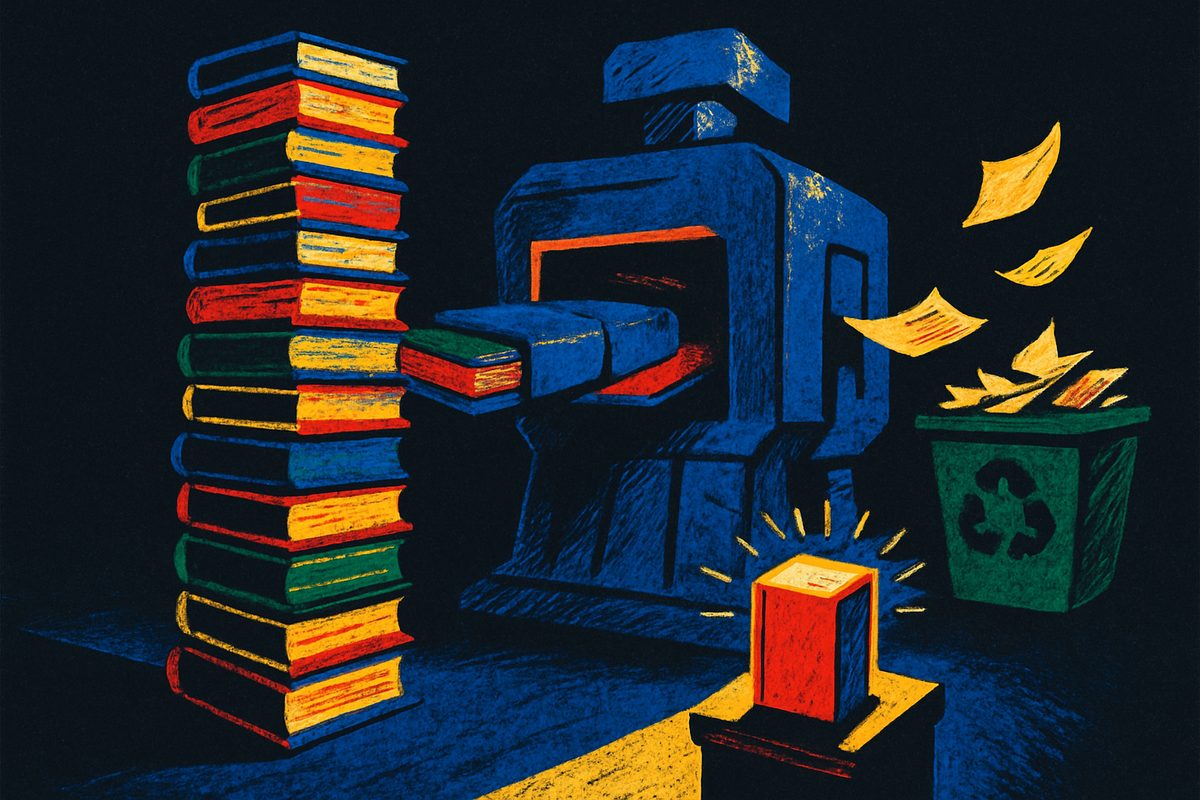
What did the National Writers Union say? On October 13, 2026, the union published a statement condemning what it calls "ongoing efforts by artificial intelligence companies to scan and destroy the world's print books." The NWU represents freelance writers and creative workers across formats and genres, and it wants the practice stopped.
The statement leans on two things already in the public record: internal Anthropic documents that came out in the Bartz v. Anthropic copyright case, and reporting from the investigative outlet 404 Media on an Amazon facility in Las Vegas.
Project Panama
According to the NWU, documents released in Bartz v. Anthropic revealed "Project Panama," which the union describes as a clandestine Anthropic operation, begun in early 2024, to build AI training data by scanning physical books at scale and destroying them in the process.
The union quotes one company memo directly: "Project Panama is our effort to destructively scan all the books in the world. We don't want it to be known that we are working on this."
The NWU says the documents show Anthropic bought hundreds of thousands to millions of books from wholesalers, cut off the bindings with box cutters, scanned the pages and then recycled the paper. "At no point were authors, publishers, or other rights holders aware that their work was being exploited for profit and destroyed," the statement says.
Bartz v. Anthropic is the authors' class action that ended in a settlement. PT has covered the settlement process as it moved forward.
The Amazon warehouse
The union says Anthropic is not alone. It points to 404 Media's August 2026 investigation, in which the outlet placed a tracking device in a shipment of rare books and followed it to an Amazon warehouse in Las Vegas. Workers there told 404 Media that their job is to take in large book shipments, cut off the bindings so the pages can be scanned quickly, and get rid of the paper afterward. A follow-up interview with an employee at the site described the process in more detail.
The NWU singles out rare and out-of-print titles as the biggest worry. These books usually have no digital edition, which is exactly why they are attractive as training material, and the union argues that destroying them "erases these works forever." It notes that, by 404 Media's account, some of the rare books involved had only a few physical copies left anywhere.
The statement does not include a response from Anthropic or Amazon.
"An alarming echo"
NWU President Alexis Gunderson did not soften the language. "Scan-and-destroy operations trample the rights of authors, illustrators, photographers, translators, and publishers, and should horrify readers, booksellers, librarians, educators, and researchers everywhere," she said. "It is an alarming echo of the book-burning campaigns that have propped up authoritarian regimes throughout history."
She added: "We must collectively resist this blatant attempt to eliminate the world's print books — and all the human labor, knowledge, and creativity they contain — and to funnel that work into increasingly unpopular for-profit artificial intelligence products."
The union also makes an access argument. If the only surviving version of a book sits inside a proprietary AI system, readers lose the ability to read it, and researchers lose the ability to check what a model says the book contains. AI output, the statement warns, can easily garble, misrepresent or leave out information.
What the union wants
The statement stops short of a specific bill or lawsuit. The NWU says it will keep pushing for "common-sense policies" that protect writers from exploitation by AI companies, and it points members to its generative AI principles and policy platform.
Why it matters for authors
Your book can be bought, scanned and binned without you ever knowing. The core complaint here is not piracy. It is that a legally purchased print copy can become training data and then vanish, with no notice to the author or publisher.
Backlist and out-of-print titles are the exposed flank. If your older books only exist in print, they are the kind of material the union says these operations want most. Keeping your rights records in order, and knowing which titles you control, matters more now than it did a year ago.
Expect this to show up in policy fights. Writers' groups on both sides of the Atlantic have spent 2026 pressing for consent and transparency rules on AI training. Physical destruction of books gives them a vivid new example, and the NWU is clearly hoping it lands with legislators and the public.
Watch for a reply. Neither company answered the union in its statement. Any response from Anthropic or Amazon, or new detail from court records, will shape how much traction this gets.
Sources
- National Writers Union: NWU Condemns Ongoing, Large-Scale Book Destruction By AI Companies (October 13, 2026)
- National Writers Union: Generative AI principles and policy platform
- 404 Media: We Tracked a Shipment of Rare Books. It Ended at an Amazon AI Training Facility (August 17, 2026)
- 404 Media: Inside the Warehouse Where Amazon Scans and Destroys Books for AI Training