The Publishing Times
All the News That’s Fit to Publish
Writing Craft · Guides
Show Don't Tell: The Complete Guide for Fiction Writers in 2026
The phrase "show, don't tell" has echoed through creative writing workshops for decades, yet its application remains one of the most elusive challenges for fict…
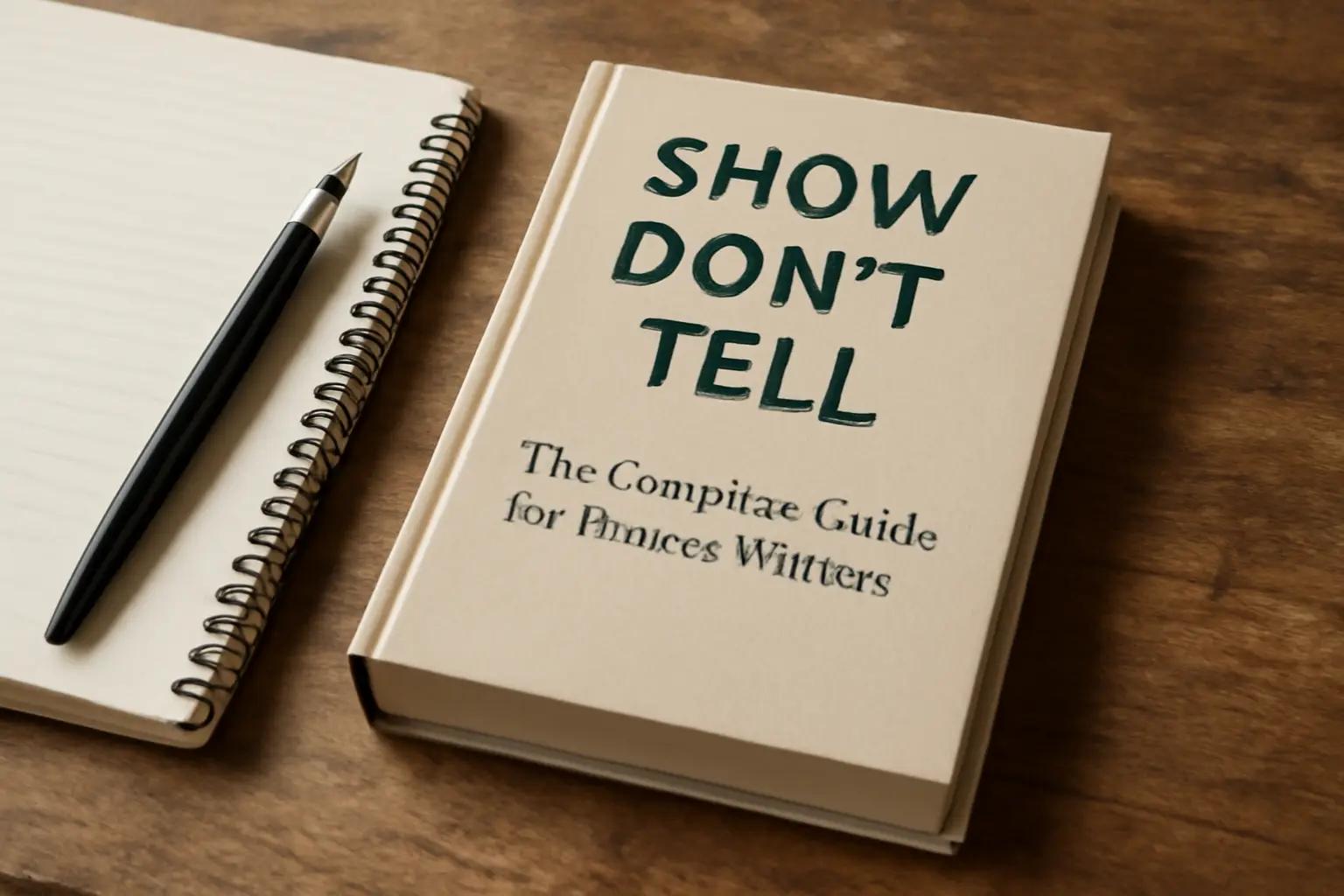
Show Don't Tell: The Complete Guide for Fiction Writers in 2026
Show don't tell is a fundamental narrative technique that replaces abstract exposition with sensory details, character action, and dialogue, allowing readers to experience the story directly. For indie authors publishing on platforms like Amazon KDP and aiming to capture modern reader attention in 2026, mastering this craft separates amateur projects from breakout commercial hits. This comprehensive guide covers everything fiction writers need to know to transform flat exposition into immersive prose, featuring step-by-step breakdowns, comparison tables, and essential workflow checklists.
Table of Contents
- Understanding the Core Philosophy of Show Don't Tell
- Step 1 of 4: Spotting Exposition and Telling in Your Draft
- Step 2 of 4: Translating Emotion into Physical Action
- Step 3 of 4: Crafting Subtext Through Dialogue
- Step 4 of 4: Utilizing Setting and Sensory Details
- Comparing Show vs. Tell Across Genres
- Case Studies in Revision Success
- Frequently Asked Questions
Understanding the Core Philosophy of Show Don't Tell
The phrase "show, don't tell" has echoed through creative writing workshops for decades, yet its application remains one of the most elusive challenges for fiction writers. In the competitive indie publishing landscape of 2026, reader expectations are higher than ever. With millions of books competing for visibility via Browse all author guides, books that rely heavily on summary and exposition fail to hook readers past the "Look Inside" sample.
At its heart, telling is intellectual; showing is experiential. When a writer tells, they act as a tour guide pointing at a landmark from a distance. When a writer shows, they drop the reader directly into the scene, handing them the object, letting them hear the sound, and forcing them to draw their own conclusions about a character's state of mind. This builds immediate psychological immersion.
However, a common trap for beginning authors is believing that everything must be shown. Total dramatization of every minor movement slows pacing to a crawl. The secret weapon of bestselling indie authors is knowing when to summarize for narrative velocity and when to dramatize for emotional impact. Understanding this balance is vital for anyone looking to build a sustainable career on The Publishing Times recommended business models.
Furthermore, digital reading platforms have changed how readers consume fiction. With quick scrolling and instant sampling, the first three chapters must rivet the reader. Exposition-heavy openings often result in high abandonment rates. By grounding your narrative in concrete physical realities early on, you secure higher page-reads on Kindle Unlimited.
Step 1 of 4: Spotting Exposition and Telling in Your Draft
The first phase of mastering show don't tell is diagnostic. You cannot fix what you cannot see. Writers must comb through their manuscripts with a specialized eye, hunting down "filter words" and summary statements that rob scenes of their vitality.
Filter words are cognitive verbs that distance the reader from the action. Words like noticed, felt, heard, saw, realized, and thought place a barrier between the character's experience and the audience. Instead of experiencing the cold wind alongside the protagonist, the reader is told that the protagonist noticed the cold wind. Eliminating these filter words forces the writer to anchor the description directly in the physical world.
Another major indicator of telling is the excessive use of "to be" verbs paired with adjectives or state-of-being nouns. Phrases like "John was angry" or "The room was messy" invite zero imagination. They are static declarations that require no active mental visualization from the reader.
To systematically clean your manuscript during self-editing, utilize modern software tools designed to flag weak prose. Many authors rely on editing suites like ProWritingAid to isolate passive voice, repetitive structures, and telling phrases. Professional resources such as Author Tools provide comprehensive breakdowns of software that can accelerate this diagnostic phase.
Step 2 of 4: Translating Emotion into Physical Action
Translating internal emotional states into external physical manifestations is the hallmark of professional fiction. When a character experiences grief, rage, or anxiety, their body reacts in specific, visceral ways. Relying on labels like "she was terrified" strips the emotion of its weight.
Instead, look at the physiological markers of fear: a dry throat, a spike in heart rate, cold sweat on the palms, or tunnel vision. By describing these involuntary physical reactions, you allow the reader to feel the terror firsthand without ever using the word "terrified."
✅ Checklist: Emotion Translation
- [ ] Remove explicit emotion labels (e.g., sad, happy, angry, nervous)
- [ ] Identify the physiological response to the emotion (e.g., shallow breathing, clenched jaw)
- [ ] Anchor the reaction to a specific object or interaction in the scene
- [ ] Ensure the physical reaction matches the intensity of the scene's stakes
It is equally important to avoid clichés. Characters should not constantly bite their lips, clench their fists until their knuckles turn white, or stare into mirrors to describe their own appearance. Fresh, unexpected physical ticks or localized environmental interactions make a character feel genuinely alive.
Step 3 of 4: Crafting Subtext Through Dialogue
Dialogue is rarely just an exchange of information. In real life, people rarely say exactly what they mean; they speak through subtext, hidden agendas, social anxieties, and polite deflections. When characters in fiction state their feelings and intentions openly, the conversation reads like an unnatural info-dump.
Consider a married couple arguing about leaving dirty dishes in the sink. If the dialogue is purely on-the-nose ("You never respect my time or help around the house because you don't love me anymore"), it sounds melodramatic and flat.
If that same argument is handled through subtext, the dishes become a battleground for a deeper marital fracture:
"The water's still running," she said, not looking up from her laptop screen.
He paused, his hand hovering over the sponge. "I was letting the pan soak."
"Right. Of course. Just like Tuesday."
"It's one pan, Sarah."
"It's never just the pan."
Here, the characters are talking about dishes, but the reader understands the heavy emotional baggage underneath. This active decoding process engages the reader's intellect, making the scene infinitely more memorable.
Step 4 of 4: Utilizing Setting and Sensory Details
Setting is not merely wallpaper; it is an active participant in your narrative. In amateur fiction, settings are often described using a static snapshot—a literal room tour where the author lists every piece of furniture. In professional fiction, setting is revealed dynamically through character interaction.
Engage all five senses, not just sight. How does the alleyway smell after a summer downpour? What does the floorboards' creak sound like under stealthy footsteps? What does the metallic taste of adrenaline feel like on the back of the tongue?
Uncover hidden telling phrases, passive voice, and pacing issues with deep-dive stylistic reports designed for fiction writers.
→ Get it on AmazonWhen a character interacts with their environment, the setting reflects their internal state. A depressed character might perceive their sunlit apartment as a dusty, oppressive cage draped in gray shadows. A joyful character might find beauty even in a drab subway station.
Weave sensory information organically into action. Rather than stopping the story to describe a medieval tavern, have the protagonist shove open the heavy oak door, duck to avoid hanging cured meats, and wipe stale ale spray from their cheek. The world builds itself around the movement.
Comparing Show vs. Tell Across Genres
Different genres handle the balance of showing and telling in unique ways. While literary fiction and thrillers often lean heavily toward immersive showing, epic fantasy and science fiction require strategic exposition to explain complex world-building systems without overwhelming the reader.
| Genre | Common Telling Mistake | The "Show" Alternative | Impact on Reader |
|---|---|---|---|
| Romance | "Mark was deeply in love with Elena." | Mark memorized her coffee order and saved the receipt in his wallet. | Builds slow-burn emotional attachment. |
| Thriller | "Agent Vance knew the suspect was lying." | Vance watched the suspect's pulse throb visibly at the carotid artery. | Increases suspense and pacing tension. |
| Fantasy | "The kingdom of Eldoria was ancient and corrupt." | Tax collectors stripped copper wire from the cathedral doors while guards looked away. | Immerses the reader in the socio-political reality. |
| Sci-Fi | "Spaceships used quantum drives to travel fast." | The cabin lurched sideways as reality tore outside the viewing port, leaving a trail of blue static. | Enhances visceral realism and awe. |
As shown in the table above, replacing abstract statements with active details transforms the reader's relationship to the text. For deeper insights into industry standards and formatting expectations, check out external publishing resources like Reedsy.
Case Studies in Revision Success
Examining real-world transformations clarifies how theoretical concepts translate into commercial viability.
Case Study: Midlist Thriller Author — Before & After
Before: Sales hovered around 50 copies per month on KDP due to high reader drop-off rates in Chapters 1 and 2, which relied heavily on background backstory dumps regarding the protagonist's police academy days.
After: Monthly KENP reads and ebook sales tripled after rewriting the opening chapters to drop the protagonist directly into an active, high-stakes hostage negotiation scene, weaving backstory organically through dialogue.
What changed: The author removed four pages of static historical exposition, replaced filter words with sensory action beats, and trusted the reader to infer the protagonist's past through professional competence.
This structural shift not only improved the book's reception in reader reviews but also boosted algorithmic visibility on Amazon, proving that craft execution directly impacts business success in the indie space.
Frequently Asked Questions
Q: Does "show, don't tell" mean I should never use summary in my novel?
A: No. Total dramatization is exhausting and ruins narrative pacing. Summary and telling are essential tools for bridging scenes, covering passage of time, and moving characters from point A to point B efficiently. Use showing for high-impact emotional moments, turning points, and key character dynamics, while reserving telling for transitional narrative summaries.
Q: How do I handle world-building exposition in science fiction or fantasy without violating the rule?
A: Use the "iceberg theory" and active immersion. Instead of explaining a magic system or political structure in a massive info-dump prologue, show characters using the system with casual familiarity in their daily lives. Let the reader piece together the rules of the world through context clues over the course of several chapters.
Q: Are filter words like "saw" and "heard" always forbidden in fiction?
A: They are not grammatically incorrect, but overuse creates psychological distance between the reader and the character. Using them sparingly is fine, but replacing them with direct sensory engagement instantly sharpens your prose and deepens immersion.
Q: How can I tell if my manuscript has too much telling during the self-editing process?
A: Look for blocks of narrative text that exceed three paragraphs without dialogue, physical movement, or environmental interaction. Additionally, search your manuscript for heavy concentrations of "to be" verbs and cognitive summary nouns. If a reader can skip a paragraph without losing plot continuity, it is likely unnecessary telling.
Q: Does showing slow down the pacing of an action scene?
A: It depends on how it is executed. Showing physical action actually speeds up pacing by making movements immediate and kinetic. However, if "showing" involves lingering on internal emotional introspection during a fast-paced battle, it will drag. Match your technique to the required tempo of the scene.
Q: What is the biggest mistake indie authors make regarding show don't tell?
A: Over-correcting by describing every mundane action—such as opening doors, sitting down, and drinking water—which leads to "stunt-double writing." Focus your showing power on moments of emotional resonance, conflict, and character revelation, rather than pedestrian mechanics.
Q: Can editing software completely fix telling issues in a novel?
A: Software can highlight potential trouble spots—such as adverbs, filter words, and passive constructions—but it cannot evaluate narrative context. An automated tool cannot tell you whether a summary sentence is a brilliant narrative bridge or a lazy info-dump. Human editorial judgment remains indispensable.
Q: How does mastering show don't tell affect my book's commercial performance?
A: Books with strong narrative immersion consistently secure better reviews, higher read-through rates on subscription services, and lower abandonment rates in retail sample previews. This directly influences algorithmic recommendations and long-term indie publishing profitability.
Conclusion + CTA
Mastering the delicate balance between showing and telling is one of the most powerful investments an indie author can make in their craft. By replacing passive exposition with visceral sensory details, grounding emotions in physical action, and building subtext into every conversation, you transform casual browsers into dedicated superfans. Remember the three core takeaways: eliminate unnecessary filter words to close the distance between reader and character, deploy telling strategically for narrative pacing while reserving showing for high-stakes emotional turning points, and let your settings and dialogue do the heavy lifting of exposition.
Stay ahead of every publishing industry change — subscribe to The Publishing Times newsletter and get the week's most important self-publishing news delivered every Monday.