The Publishing Times
All the News That’s Fit to Publish
publishing-news · Guides
France's Prix Pascal Will Reward a Manuscript Written With AI
France's new Prix Pascal will award an unpublished French manuscript written with AI help. The homepage and the rules PDF disagree on the opening date and on length. The cash amount is not stated.
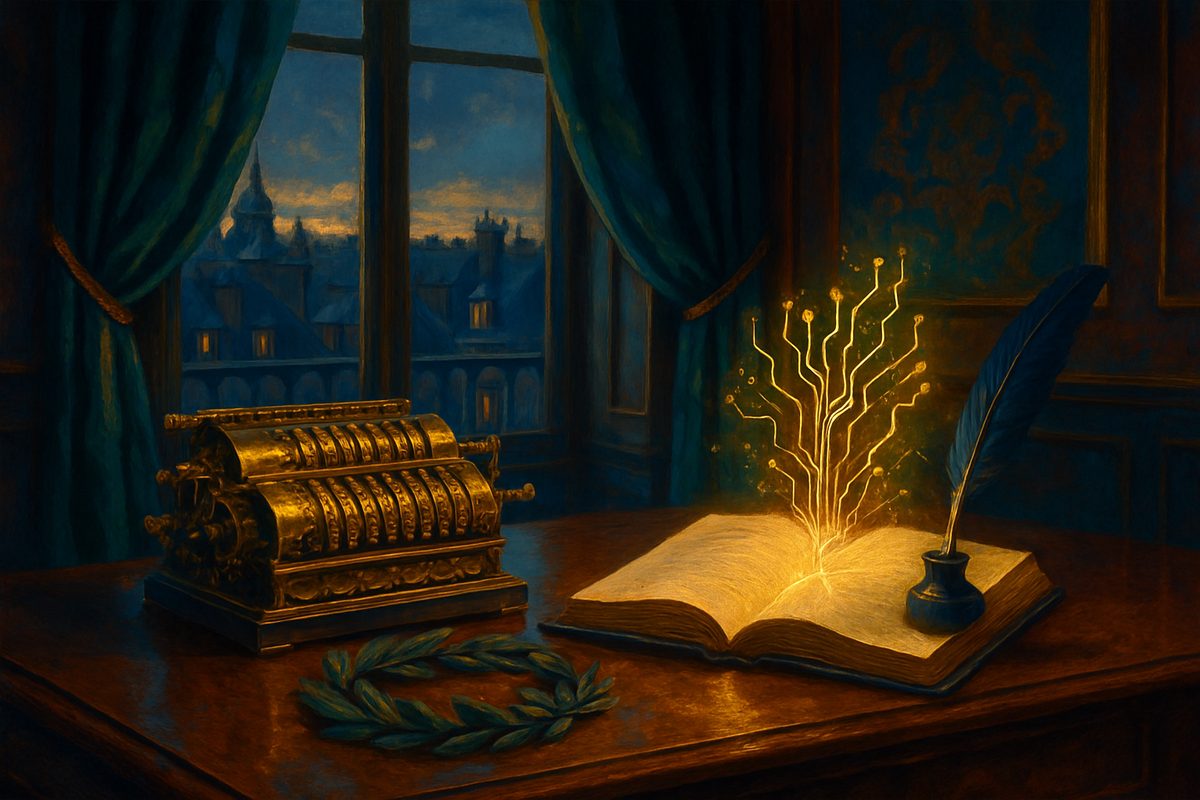
What is the Prix Pascal? A first-edition 2026 prize for an unpublished French-language manuscript written with AI help. The Prix Pascal de Littérature IA says a jury of authors and critics will reward the best work co-written with an AI. In translation, the site says this prize is not a technology contest.
The site names it for Blaise Pascal: in 1642, at nineteen, he invented the Pascaline, which the site calls the first mechanical calculating machine, and his Pensées are among the high points of French literature.
What an entrant sends, and where the rules split
Three items go in together. A "graine," the seed or prompt. The manuscript. A technical file that names the model and describes the process. The rules PDF says any person or legal entity may enter, of any nationality, up to three times. The manuscript must be in French, unpublished, and anonymous. No publisher is required. In translation, the PDF requires a declaration on the candidate's honor that the work was produced with AI assistance, that no pre-existing human text was inserted by hand except the seed, and that the technical file is accurate. A candidate shown to have given false information is disqualified and barred for the next three editions.
The homepage and the PDF disagree. Check the rules before relying on either page.
The homepage says entries open on October 20, 2026. The PDF says they open on November 2, 2026. Le Figaro, in a story by Romain Ferrier published October 19, gives November 2. Livres Hebdo, in a story by Souen Léger published October 16, reported that the site then showed an opening on November 2, 2026.
Length splits the same way. The homepage describes a manuscript of 300,000 characters, spaces included, and a seed of about 4,000 characters, roughly two pages. The PDF sets the manuscript at 10,000 to 50,000 words and the seed at 100 words maximum. Le Figaro follows that word count and the 100-word seed. Livres Hebdo reports the 10,000 to 50,000 word range.
The two official documents agree on the rest of the calendar. The deadline is the end of November. The PDF puts it at November 30, 2026, 23:59 Paris time, and puts the choice of 10 nominees on that same date. The ceremony is in early December. The PDF says the winner receives a cash award, publication, and press attention, and that each of the 10 finalist works receives a cash award too. Neither page states the sum. Le Figaro says the amount is not yet known. The homepage says the prize will try to have the winning manuscript published, and that the winning seed is released only with the author's consent.
How the jury is told to judge
A condition comes first. The site, in translation, says the work has to be useful, or alert, or help solve in an original way one of the ecological, social, and ethical challenges that threaten humanity. The PDF then sets two criteria. Creativity: a form or a voice that nothing already in existence led a reader to expect. New methods: a way of making the work that had not been used before, described in the technical file precisely enough that another author could take it up and change it. In translation, the rules say the works that manage this are hard for a person alone to reproduce and, above all, bring something useful to humanity.
The homepage FAQ says any large language model is allowed, naming ChatGPT, Claude, Gemini, Mistral, LLaMA, and any other LLM. The FAQ says that declaration is information for the jury, and that it is not a reason to reject the entry. No professional career is required. On size, the homepage says five jurors and the PDF says five to nine, an odd number, with a president's tie-breaking vote. The homepage and Le Figaro say the names will be revealed in early November.
Who is expected to sit, and who is not named
Le Figaro and Livres Hebdo report that Jacques Attali is expected to chair, and that Alexandre Gefen, a research director at the CNRS, is expected to sit. Livres Hebdo attributes that to Gefen himself. At an October 15 talk for Normandie Livre & Lecture, he said, in the paper's quotation: "Le prix Pascal doit couronner le meilleur texte jamais produit par une IA." In translation: "The Prix Pascal should crown the best text ever produced by an AI." He said the jury was still being formed and that Jacques Attali would preside. Livres Hebdo is reporting his account. The prize site has published no roster.
The founder has not been named in full in public. Le Figaro, citing Les Echos Weekend, describes him as a private mergers-and-acquisitions specialist identified only as "Philippe R.," neither writer, journalist, nor publisher. The paper says the idea began in June at the restaurant Drouant, in a meeting with Philippe Claudel, whom it calls president of the Académie Goncourt. Livres Hebdo adds Albin Serviant, founder of Cortex House, among the organizers.
The prize arrives weeks after the Goncourt affair around Thélyson Orélien. Le Figaro says the Haitian author was accused in early September of using AI for C'était ça ou mourir (Grasset). Livres Hebdo says he was disqualified from the Goncourt over AI suspicions. PT reported the removal of the novel and Orélien's admission of past plagiarism and his denial that AI wrote the book.
Why it matters for authors
An entrant has to declare the AI help and file the seed, the manuscript, and the technical file together. In translation, the PDF keeps the manuscript and the technical file as the candidate's property, lets winners and finalists mention the result without asking, and puts the prize mark with the unnamed association that runs it. French law governs, the courts of Paris are named, and the contact is contact@prixpascal.fr.
Check the rules. The homepage and the PDF disagree on opening day (October 20 or November 2), on manuscript length (300,000 characters including spaces, or 10,000 to 50,000 words), and on the seed (about 4,000 characters, or 100 words at most). The PDF's deadline is 23:59 Paris time on November 30, 2026. The cash amounts are not stated.