The Publishing Times
All the News That’s Fit to Publish
publishing-news · Guides
European Writers' Council Tells MEPs AI 'Is Not a Tool' in Feedback on Parliament's Culture Report
Europe's largest authors' body wants Parliament's draft report on culture and AI to drop the 'opportunity' framing, require opt-in consent and label AI fiction, including on self-publishing platforms.
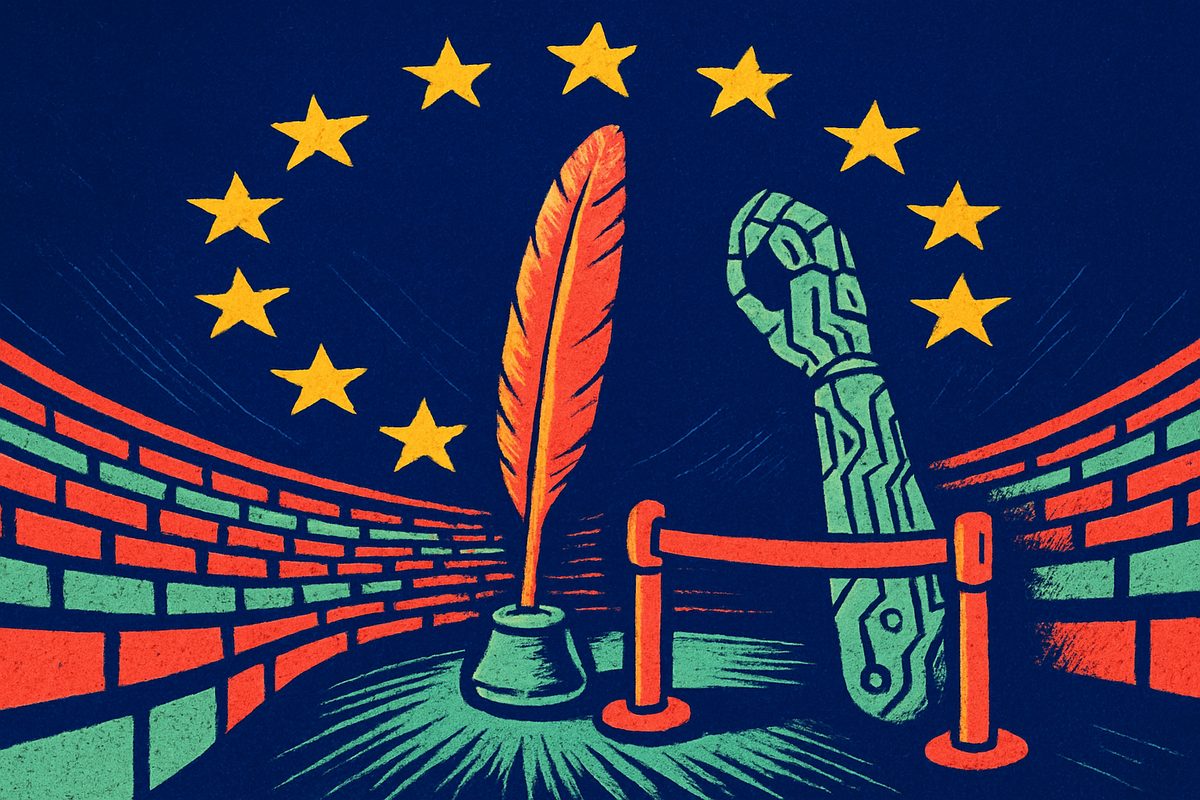
What does Europe's biggest writers' body want from the European Parliament on AI? A harder line. In written feedback posted on October 12, the European Writers' Council (EWC) told the MEPs drafting Parliament's report on culture and AI that generative AI "is not a tool" for authors but "a threat to our profession, our livelihoods and our working conditions."
The EWC says it represents 55 writers' organisations from 34 countries, or about 260,000 writers and translators. Its letter, dated Brussels, October 8, is addressed to rapporteur Hélder Sousa Silva, the shadow rapporteurs and members of the Culture and Education (CULT) Committee.
The report it is answering
The procedure is 2025/2180(INI), titled "Cultural and creative sectors in the age of AI." Parliament's Legislative Observatory lists it as an own-initiative report in the CULT committee, with Sousa Silva (EPP) as rapporteur. The draft report, PE786.971, is dated September 9, 2026. The stage reached is "Awaiting committee decision."
An own-initiative report does not make law on its own. It sets out where Parliament stands. The EWC says it expects the European Commission's AI strategy for the cultural and creative sectors early next year, and it wants the report to shape that.
What the writers like
The letter is not all complaint. The EWC says the draft's overall approach is "sound and constructive" and that many of its own suggestions made it in.
It thanks the rapporteur for citing the ART principle (Authorisation, Remuneration, Transparency), which it says EWC vice president Maïa Bensimon devised in 2023. It welcomes the draft's admission that opt-out systems are not working, and its call on the Commission to assess the real impact of AI on authors' jobs and income.
Two passages on books get specific praise. The EWC quotes point 22, on "the proliferation of unlabelled, fully AI-generated books, including publications attributed to fictitious human authors, which may mislead readers." And it quotes point 23, which calls for labelling requirements for synthetic text "to be extended beyond AI developers to online booksellers, distributors and self-publishing platforms," and asks those intermediaries to provide "clear labelling and filtering mechanisms for fully AI-generated publications."
What the writers want changed
Drop the "opportunity" framing. The EWC objects to language that treats AI as a "tool," an "opportunity" or at most a "challenge." It wants the draft's recital saying AI is "already used across the cultural and creative sectors" removed, on the grounds that this is not the reality for most European literary authors.
Use precise words. It asks for a clear definition of AI, a line between "work" (made by a human and protected) and "content," and between "create" and "generate." It wants the report to stick to AI Act terms like "AI-generated" and "AI-manipulated" and to avoid "AI-assisted," which it says has no clear legal definition.
Opt-in, not opt-out. The EWC says most European authors do not want their books used to train AI and argues that permission should work as it does for print or audio rights: explicit, individual, opt-in. It wants developers of every size to be obliged to seek licences, including those using retrieval (RAG) and prompting features.
Label the fiction too. This is the sharpest section. The EWC says the Commission's transparency guidelines and the AI Office's Code of Practice on transparency only require labels on AI text published to inform the public on matters of public interest. In its reading, AI products that imitate novels or poems would not have to be labelled. "Which means in reality, that all scam AI books on Amazon – approx. half a million – are not obligated to be labelled. This is consumer fraud," the letter says. The half-million figure is the EWC's own estimate. It goes further than the draft, too, asking for AI-manipulated work to be labelled as well. "Only 100% human labour should be acknowledged as original work," it writes.
The letter also says a recent Parliament briefing on AI in the audiovisual, publishing and music streaming sectors (PE 787.221) was not neutral, and that the EWC was not consulted on it.
It is signed by secretary general Nicole Pfister Fetz, president Sebastià Portell Clar, political affairs commissioner Nina George and coordinator Zsuzsánna Dóczy.
Why it matters for authors
Self-publishing platforms are named in the draft. Point 23, as the EWC quotes it, would push labelling and filtering duties for fully AI-generated books onto online booksellers, distributors and self-publishing platforms. If that survives into the final text, it is a signal of where EU rules may go for the stores indie authors sell through.
Watch the word "assisted." Retailers already sort AI use into categories. KDP, for one, asks authors to disclose AI-generated content but treats AI-assisted work differently. The EWC wants EU texts to avoid "AI-assisted" altogether and to label AI-manipulated work. Definitions in Brussels can end up in the forms you fill in when you publish.
The fight is over permission and pay. Opt-in consent, licensing for every developer and remuneration that is "adequate and proportionate" are the EWC's three asks. None of that is law yet. Amendments come next in committee.
Sources
- European Writers' Council: EWC calls for a more ambitious stance within the Draft Report 2025/2180(INI) (October 12, 2026)
- European Writers' Council: Full feedback letter to the CULT Committee (PDF) (dated October 8, 2026)
- European Parliament Legislative Observatory: Procedure file 2025/2180(INI), Cultural and creative sectors in the age of AI