The Publishing Times
All the News That’s Fit to Publish
publishing-news · Guides
Polish Publishers Fight a Fixed Book Price Law
Polish publishers have been campaigning against a draft law that would fix the retail price of new books, The New Publishing Standard reported.
Poland's book publishers have been campaigning against a draft law that would fix the retail price of new books, The New Publishing Standard reported on 15 November 2026.
On 22 October, houses including Znak, Rebis, Muza and Helion launched the campaign "Nie podnoście Polakom cen książek", the report said. The report renders that name in English as Don't Raise Book Prices for Poles. The group is also known as the Book Publishers Association, or PWK, the report said.
The draft, known as the Act on the Protection of the Book Market, would fix retail prices for new books during their first 12 months on sale, cap wholesale distribution discounts at 45%, create a national sales-reporting system, and guarantee minimum royalties of 10% of cover price for authors and 3% for translators, The New Publishing Standard reported.
The Ministry of Culture argues the rules would shield independent bookshops from dominant chains, the report said. 14 industry organisations have demanded publication of the full text before a promised vote around March 2027, the same report said.
The campaign argues that uniform pricing would raise reader prices and could keep new e-books and audiobooks off subscription services for a year, The New Publishing Standard reported. NielsenIQ BookData shows print unit sales fell 11.3 percent year-on-year in the first half of 2026, the report said.
The ministry has dismissed the campaign as misinformation. The Book Publishers Association rejected that charge on 29 October, insisting its members are small and medium-sized houses, The New Publishing Standard reported.
How long the fight has been running
The dispute has deep roots, The New Publishing Standard reported. Poland's first draft pricing bill dates to 2017, and the Polish Book Chamber later tabled a 2021 proposal fixing prices for 12 months with discounts capped at 5%, the report said.
In December 2025 the Culture Ministry announced it would incorporate Book Market Roundtable recommendations into legislation, The New Publishing Standard reported.
A February 2026 simulation by Warsaw School of Economics professor Michał Bernardelli, drawing on NielsenIQ data covering roughly 40 percent of the market, concluded fixed prices would level the playing field, the report said. The Book Publishers Association questioned the data, according to the same report. In July 2026, the competition watchdog UOKiK warned the bill could damage market competition, The New Publishing Standard reported.
What the campaign says readers would pay
The report in Rzeczpospolita is dated 23 October 2026. Rzeczpospolita reported that leading houses in the publishers' group, including Znak, Rebis, Muza, Helion, Nasza Księgarnia, Media Rodzina and Zysk i S-ka, started the campaign on social media.
According to figures presented by the houses and printed by Rzeczpospolita, a typical 30 percent discount would be blocked for a new book's first year, so a title now bought for about 35 zloty would sell at a 50 zloty cover price. "Za 100 zł, które dziś wystarcza na zakup trzech książek, po zmianach moglibyśmy kupić zaledwie dwie," the protest said, as Rzeczpospolita printed it.
The houses also warned that new e-books and audiobooks may reach streaming platforms only after a delay, Rzeczpospolita reported. "Zgodnie z zapowiedziami na nowości (wydawnicze) w serwisach abonamentowych poczekamy aż rok," they said, as the paper printed the line.
What the ministry says
The Ministry of Culture and National Heritage rejected those charges, Rzeczpospolita reported. Its spokesman, Piotr Jędrzejowski, in a statement sent to the Polish Press Agency, described the publishers' action as "szerokiej kampanii dezinformacyjnej wymierzonej w rozwiązania, które mają rynek książki uporządkować," the paper reported.
Jędrzejowski said: "książka jest dziś jedynym towarem, który trafia na rynek od razu przeceniony." Discounts of as much as several tens of percent are a regular practice among a few of the largest players, he said, according to Rzeczpospolita. The ministry's view, the paper reported, is that cover prices are raised so that distributors and publishers can then offer a striking discount of 35 to 40 percent.
The spokesman argued that a uniform price law would not raise the real cost of buying a book, but would make list prices reflect what readers actually pay, Rzeczpospolita reported. He pointed to a 2024 study in the Journal of Competition Law & Economics by Rhys J. Williams of Cambridge Judge Business School. In countries that use uniform book prices, average prices did not rise, and volume sales were 11 to 16 percent higher than in countries with fully free book pricing, the paper reported, citing that study.
The writer and translator Piotr Tarczyński also accused large publishers of manipulation, Rzeczpospolita reported.
What else is in the draft
The bill is meant to guarantee authors a minimum of 10 percent of cover price and translators at least 3 percent, and to put in place an automated system for reporting sales data, Rzeczpospolita reported.
The ministry told the paper that the draft has gone to the Team for Programming Government Work. Once it is formally listed in the government's legislative programme, the full text will be published and opened to public and industry consultation, including the publishers now in protest, Rzeczpospolita reported.
Europe and the state of the shops
Poland would join around 13 European states with fixed book prices, including Germany, where the tradition dates to 1888 and was given statutory force in 2002, and France, under the 1981 loi Lang, The New Publishing Standard reported. The UK's Net Book Agreement, by contrast, collapsed in 1995, the report said.
Between 2010 and 2020 nearly a third of bookshops closed, while chains command wholesale discounts of 50 to 70 percent against 20 to 50 percent for independents, The New Publishing Standard reported. With at least five Polish houses closing or suspending in 2026, publishers argue higher prices will shrink print runs and title diversity, the report said. The consultation, and whether the royalty floor survives intact, will decide the shape of a market of growing continental significance, The New Publishing Standard wrote.
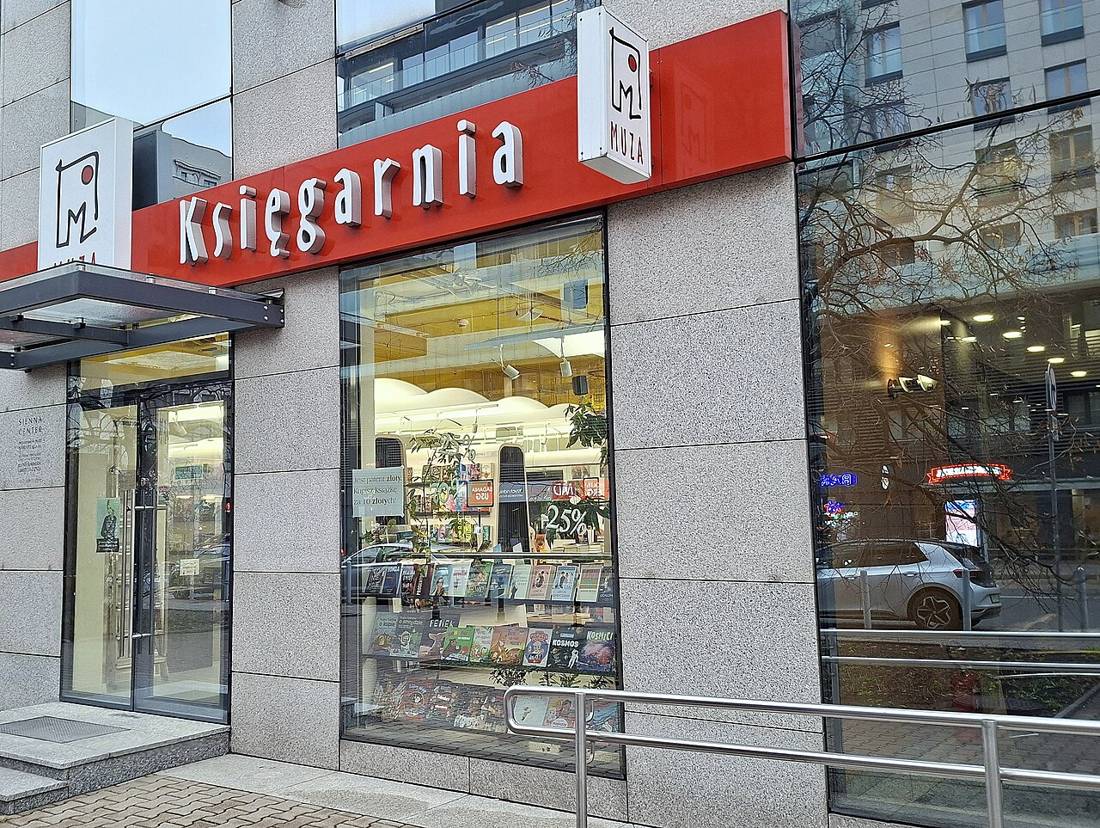
Photo: Bookstore of Muza at 73 Sienna in Warsaw, photographed on 27 November 2025 by Lowdown, via Wikimedia Commons, CC BY-SA 4.0. The photograph is not from the advertising campaign.
