The Publishing Times
All the News That’s Fit to Publish
forgotten-authors · Guides
Marie Corelli Was the Bestselling Novelist of Her Age. Then Readers Moved On.
In the 1890s she was Britain's bestselling novelist. By 1940, her royalties came to £73 a year.
In 1895, a London novelist did something publishers considered close to madness. She refused to send out review copies of her new book. She even said so at the front of it.
The novel was The Sorrows of Satan, and the author was Marie Corelli. Critics had been sneering at her for nearly ten years, and she had decided to go straight to readers. It worked. The book sold 25,000 copies in its first week and 50,000 within about two months. Her biographer Teresa Ransom and the scholar Annette Federico have both called it the first modern bestseller. It went through 60 editions before she died.
Today, outside a small circle of scholars, almost nobody reads her. How that happened says a lot about what keeps a writer's name alive.
The invented Venetian
Marie Corelli was not Venetian, and Marie Corelli was not her name. She was born Mary Mackay in London, probably in 1855, the illegitimate daughter of the Scottish songwriter and journalist Charles Mackay. Even her birth is uncertain; researchers still argue over which records are hers.
She spent her life covering that up. When she approached her first publisher, George Bentley, she wrote, "I am Venetian and can trace myself back to the famous musician Arcangelo Corelli." She claimed she had been 17 when her first novel came out. She had actually been about 30.
She began as a pianist, giving recitals in late 1884 as "Signorina Marie di Corelli." In 1885 she earned 10 guineas for a magazine article about a grotto at Margate and finished a novel called Lifted Up. Bentley's readers split on it, and one of them, the novelist Hall Caine, turned in a negative report. Bentley read it himself and took it. Retitled A Romance of Two Worlds, it came out in February 1886, and she was paid £40.
The critics dismissed it, and readers bought it. That pattern held for the rest of her career.
The queen of the bestseller
Her third novel, Thelma (1887), made her a fixture of London society lunches. At one of them Oscar Wilde told her, "Such a lot of talking-about-you does more good than an infinite number of bad reviews." In 1891, after borrowing a copy of A Romance of Two Worlds, Queen Victoria asked for a presentation copy and gave instructions that all of Corelli's books be sent to her on publication.
The reviewers never came around. The critic James Agate summed her up as combining "the imagination of a Poe with the style of an Ouida and the mentality of a nursemaid." Corelli answered in fiction. In The Sorrows of Satan she wrote in a character named Mavis Clare, a pretty young novelist whom critics despise and readers adore.
The numbers stayed on her side. Our Warwickshire, the county's community heritage site, says she sold more books than Rudyard Kipling, Arthur Conan Doyle and H. G. Wells combined. When Temporal Power came out in 1902, Methuen paid her a £5,000 advance and printed a first edition of 120,000 copies. That August she attended the coronation of Edward VII, and according to a timeline compiled by the Stratford historian Nick Leigh Birch, she was the only author there. By 1908 her income was estimated at about £18,000 a year.
Stratford's great little lady
In 1899, worn out after surgery, Corelli moved to Stratford-upon-Avon with her lifelong companion, Bertha Vyver. They settled at Mason Croft, a house on Church Street, in 1901.
Stratford never quite knew what to do with her. She rode around town in a small carriage pulled by two Shetland ponies named Puck and Ariel. She bought a Venetian gondola and imported a gondolier to row it on the Avon, then sent him home after he took too well to the local pubs. She also fought, loudly, to save the town's old buildings. In 1903 she campaigned against demolishing Tudor-era cottages near Shakespeare's Birthplace for a new Carnegie library, and the plans were changed. When a local man, Fred Winter, accused her in the press of hypocrisy, she sued him for libel and won. The jury awarded her one farthing.
She bought Harvard House, built in 1596 for John Harvard's grandfather, to keep it from being demolished or modernized. With an American donor she restored it and gave it to Harvard University in 1909. "A lot of the ancient fabric of the town is only here thanks to her efforts," Maureen Bell of the University of Birmingham told The Guardian in 2006.
The campaigns also made her enemies in town.
The fall
During the First World War, after a heavy fruit harvest in her orchard, Corelli tried to get extra sugar for preserving at a time of rationing. She was charged with food hoarding and convicted by the local magistrates on January 2, 1918. Her old adversary Fred Winter was among the magistrates. She was fined £50 plus 20 guineas in costs, and newspapers across the country called her a hypocrite. She had spent the war writing patriotic articles to raise money, and the verdict wounded her.
Something larger was happening, too. The Sorrows of Satan had sold more than 200,000 copies by 1918, and many of her other titles had passed 100,000. But her yearly sales were falling. Her florid, moralizing novels about faith, reincarnation and mysticism belonged to the 1890s, and after the war readers wanted something else. Her later books and her public opinions were increasingly out of step with the times.
She died at Mason Croft on April 21, 1924.
Why she disappeared
Plenty of popular writers fade. Corelli faded more completely than most, and the record suggests why.
The critics had never been on her side, so when readers left, nobody in the literary world argued for her. Much of her fame had also rested on her personality, the gondola and the feuds, and personalities date faster than books. Then there was the money. Bertha Vyver lived on at Mason Croft and kept Corelli's rooms exactly as she had left them, with fresh flowers. But the royalties dwindled. In 1940, according to biographer Brian Masters, they came to £73.
Vyver died in 1941. Corelli's will had tried to turn Mason Croft into a trust, partly for the benefit of distinguished visitors from overseas. The estate didn't have the income to run it, and in 1943 a court declared the will void, in part because the trust was meant to benefit foreigners. Over three days that October, the contents of the house went at auction for knock-down prices. The University of Birmingham bought Mason Croft in 1951, and it is now the university's Shakespeare Institute. In 1953 her literary agents handed the rights to her work to Methuen for £750.
In 2007 the French director François Ozon released Angel, adapted from Elizabeth Taylor's novel, and said its heroine was inspired by Corelli. He called Corelli "one of the first writers to become a star, writing bestsellers for an adoring public. Today, she has been largely forgotten, even in England."
A small revival
She is not completely gone. Scholars have started reading her again. In 2006, 55 academics came to a conference about her and her contemporaries at Mason Croft, her old house. Nickianne Moody, one of the organizers, told The Guardian that people had queued to buy her books on publication, and that the books "sold in their millions." The marble angel on her grave, toppled by vandals in 2012, was repaired and put back in 2017 after a local campaign.
Corelli spent her career insisting that readers should decide which books matter. For about thirty years she was right. What she didn't foresee was that readers would move on, and that once they did, there would be no one else left to remember her.
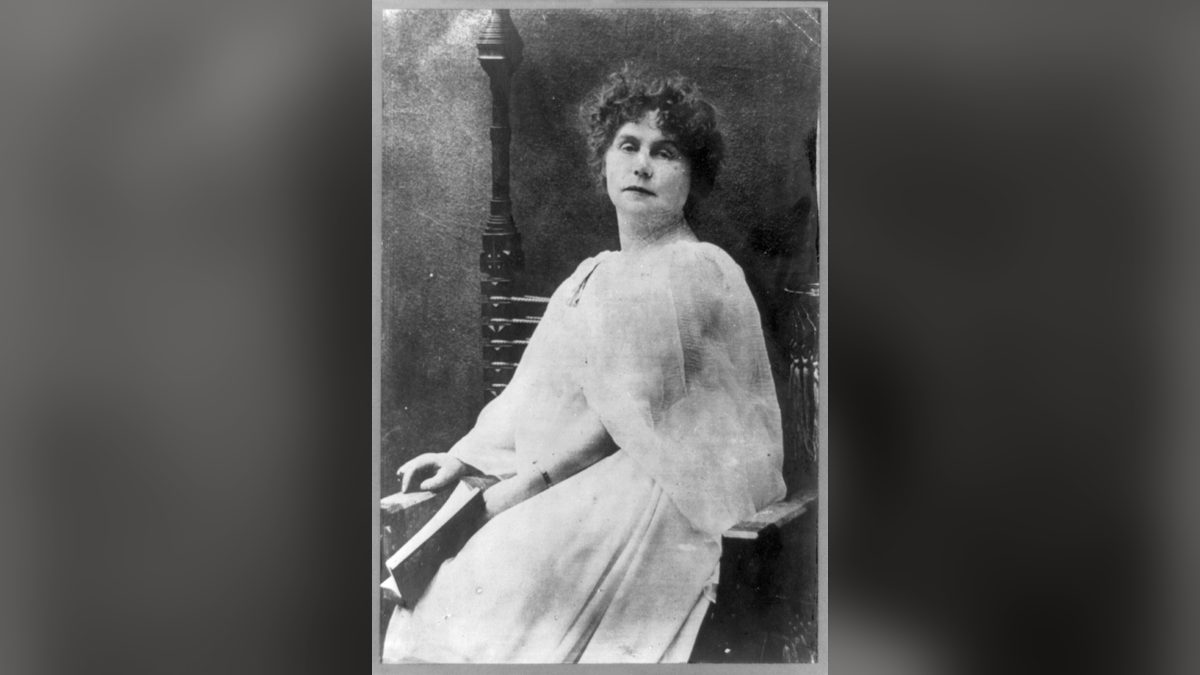
Image: Marie Corelli, three-quarter length portrait, seated, holding a book, 1904. Library of Congress Prints and Photographs Division (LCCN 89706402). Public domain, via Wikimedia Commons.

Sources
- "Timeline," mariecorelli.org.uk (Nick Leigh Birch, Stratford-upon-Avon, drawing on Shakespeare Birthplace Trust archives, Vyver, Masters and Ransom). https://mariecorelli.org.uk/timeline (piano recitals 1884, Margate article, Lifted Up, Hall Caine's report, £40, Wilde quote, Queen Victoria 1891, refusal of review copies, Temporal Power advance and print run, coronation, 1908 income, sugar conviction and fine, 1918 sales figures, 1943 auction, 1951 university purchase, 1953 rights sale)
- Nick Leigh Birch, "Life of Marie Corelli 1899–1924: Stratford-upon-Avon's 'Great Little Lady'" (from Reinventing Marie Corelli for the Twenty-First Century, Anthem Press, 2019), mariecorelli.org.uk. https://mariecorelli.org.uk/1899-1924 (1899 move after illness, Mason Croft, ponies, gondola, Carnegie library fight, farthing damages, Harvard House, Fred Winter on the bench, out of step after the war, death, Vyver's upkeep of the house, £73 royalties in 1940 citing Masters p. 286, angel repaired 2017)
- "Marie Corelli," Wikipedia. https://en.wikipedia.org/wiki/Marie_Corelli (birth as Mary Mackay, Bentley letter quote citing Masters, false age claim, Agate quote, Ozon quote, sales comparison)
- Justin Rogers, "Marie Corelli, The Sorrows of Satan," The Literary Encyclopedia. https://www.litencyc.com/php/sworks.php?UID=10894&rec=true (25,000 in first week; 50,000 after seven weeks)
- "Sorrows of Satan, The," reference entry, Springer Nature Link. https://link.springer.com/rwe/10.1007/978-3-030-02721-6_348-1 (first modern bestseller per Ransom and Federico; no review copies; 60 editions by 1924)
- "Comedy, Christianity and Melodramatic Affect: The Sorrows of Satan at the Shaftesbury Theatre," SAGE Journals. https://journals.sagepub.com/doi/10.1177/17483727211006839 (25,000 in a week; 50,000 through eight editions in under two months)
- Chris Arnot, "The cultural resonance of Marie Corelli," The Guardian, April 11, 2006. https://www.theguardian.com/education/2006/apr/11/workinprogress.highereducation (gondolier, Maureen Bell and Nickianne Moody quotes, 55-academic conference)
- "The Great War and Miss Corelli's Garden," Our Warwickshire. https://www.ourwarwickshire.org.uk/content/article/great-war-miss-corellis-garden (outsold Kipling, Conan Doyle and Wells combined; Mason Croft now the Shakespeare Institute)