The Publishing Times
All the News That’s Fit to Publish
Editorial · Guides
The Credibility Crisis of AI in Publishing: A Threat to Authors and Trust
Artificial Intelligence promised efficiency, but in publishing, it delivers a crisis of credibility that threatens the very foundation of authorship and reader trust. The industry must act decisively.
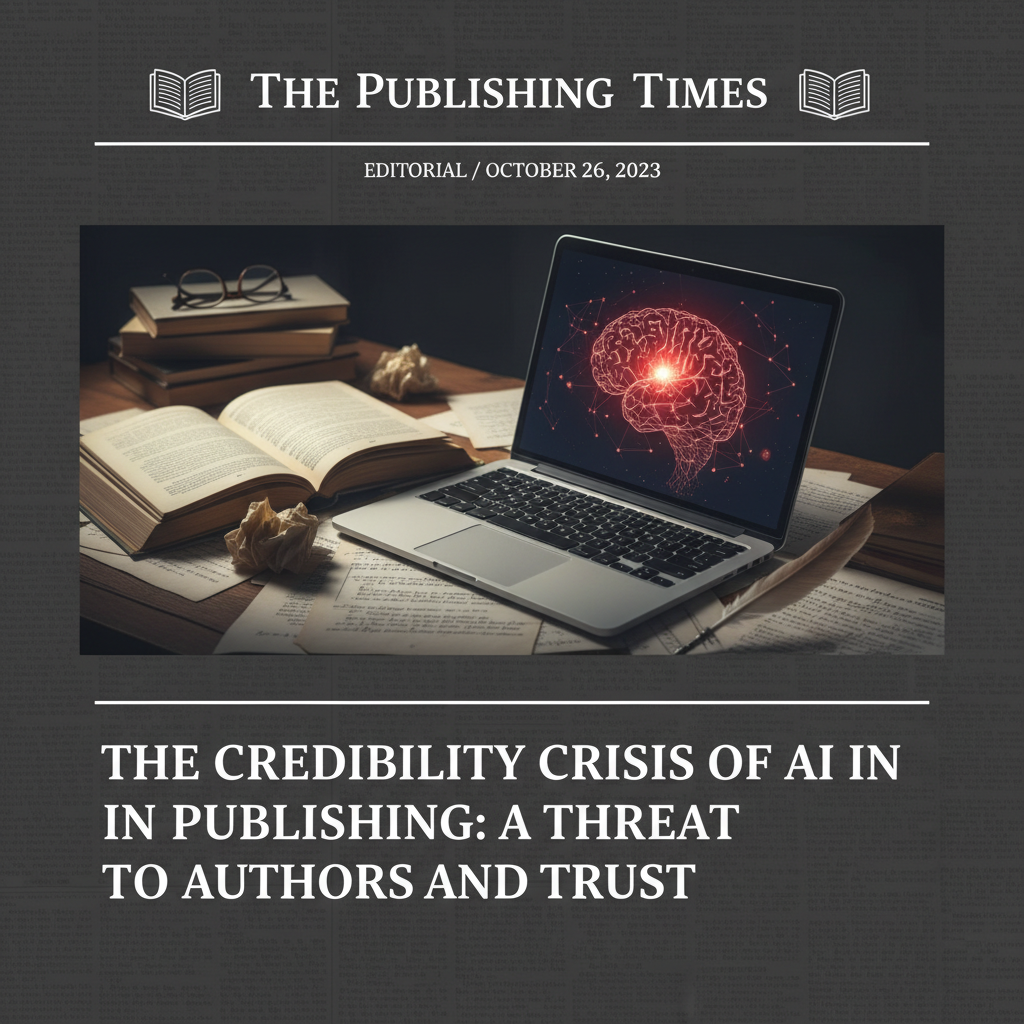
The publishing industry stands at a precipice, staring down a crisis of its own making: the widespread, often undisclosed, integration of Artificial Intelligence. What began as a whisper of efficiency has become a clamour of concern, eroding the bedrock of trust between author, publisher, and reader. The **credibility crisis of AI in publishing** is not merely theoretical; it is a clear and present danger to the integrity of our craft and the livelihoods of genuine creators.
For too long, the allure of automation blinded some to the fundamental value of human authorship. Now, the consequences are undeniable. Readers, discerning as ever, are increasingly wary. A significant majority of the public believes it is crucial to know if content is AI-generated, yet over half doubt their ability to tell the difference. This 'trust deficit' creates a minefield for authors and publishers alike. Undisclosed AI usage risks a severe backlash, while overuse can strip a work of the authentic voice readers crave. The very notion of a book being 'human-written' is fast becoming a premium commodity, a badge of honour in a sea of synthetic prose.
## The Erosion of Authorship and Trust
The core issue is simple: copyright law, at least in the United States, hinges on human authorship. Material produced by an AI system without significant human creative control does not qualify for protection. This means that a work churned out by a machine, even if polished, is commercially worthless in the traditional sense, as publishers cannot own the copyright. This legal quagmire alone should give pause, yet the market continues to be flooded with AI-generated titles, particularly in the self-publishing arena.
Beyond the legalities, there's the profound ethical breach. When an author claims a work, it implies their unique thoughts, words, and imaginings. Falsifying this, by passing off AI-generated text as human-written, shatters the trust vital to a healthy literary culture. The Authors Guild rightly asserts that writers, not AI companies, should dictate how these technologies are used in their profession, given that AI companies have shown a distinct lack of concern for the future of literature and its ethics.
> "The publishing world is a tight-knit community. An author caught attempting to pass off AI work as original often faces 'blacklisting.' Once your reputation for integrity is compromised, finding another house to represent your work becomes nearly impossible."
## The Publisher's Peril and Path Forward
Publishers, both traditional and independent, are not immune. Many now implement stringent policies, with some having a zero-tolerance approach for entirely AI-generated manuscripts. Detection tools are becoming more sophisticated, capable of distinguishing between human prose and machine patterns, though they are not without their flaws. The repercussions for undisclosed AI usage are severe: immediate rejection, contract termination, and even professional blacklisting. The integrity of the publisher's brand, and by extension, the entire industry, rests on ensuring that published works are products of human creativity.
Moreover, the use of AI in editing or summarising manuscripts without explicit author permission raises serious intellectual property and privacy concerns. Publishers must ensure that authorial work is not inadvertently used to train AI models, safeguarding both copyright and confidentiality. The challenge extends to the academic sphere, where the proliferation of AI-generated fake papers threatens to undermine public trust in research itself. This is a **credibility crisis of AI in publishing** that demands a unified, ethical response.
The industry must embrace transparency. Clear disclosure of AI involvement is paramount, not merely as a tick-box exercise but as a commitment to authenticity. Authors must be encouraged to use AI as a tool for assistance—for brainstorming, research, or grammar checks—rather than as a ghostwriter. The distinction between AI-generated and AI-assisted content is crucial, and platforms like KDP are beginning to mandate disclosure for the former. For those seeking to understand the nuances, resources like *AI Best Practices for Authors* (available on [Amazon](https://amazon.com/AI-Best-Practices-Authors/dp/B0C951J32T))?tag=seperts-20 offer valuable guidance.
This is not a call to shun technological progress, but to harness it responsibly. The unique voice, lived experience, and imagination of a human author remain irreplaceable. It is our collective duty to champion these qualities, ensuring that the future of publishing is built on genuine artistry and unwavering trust.